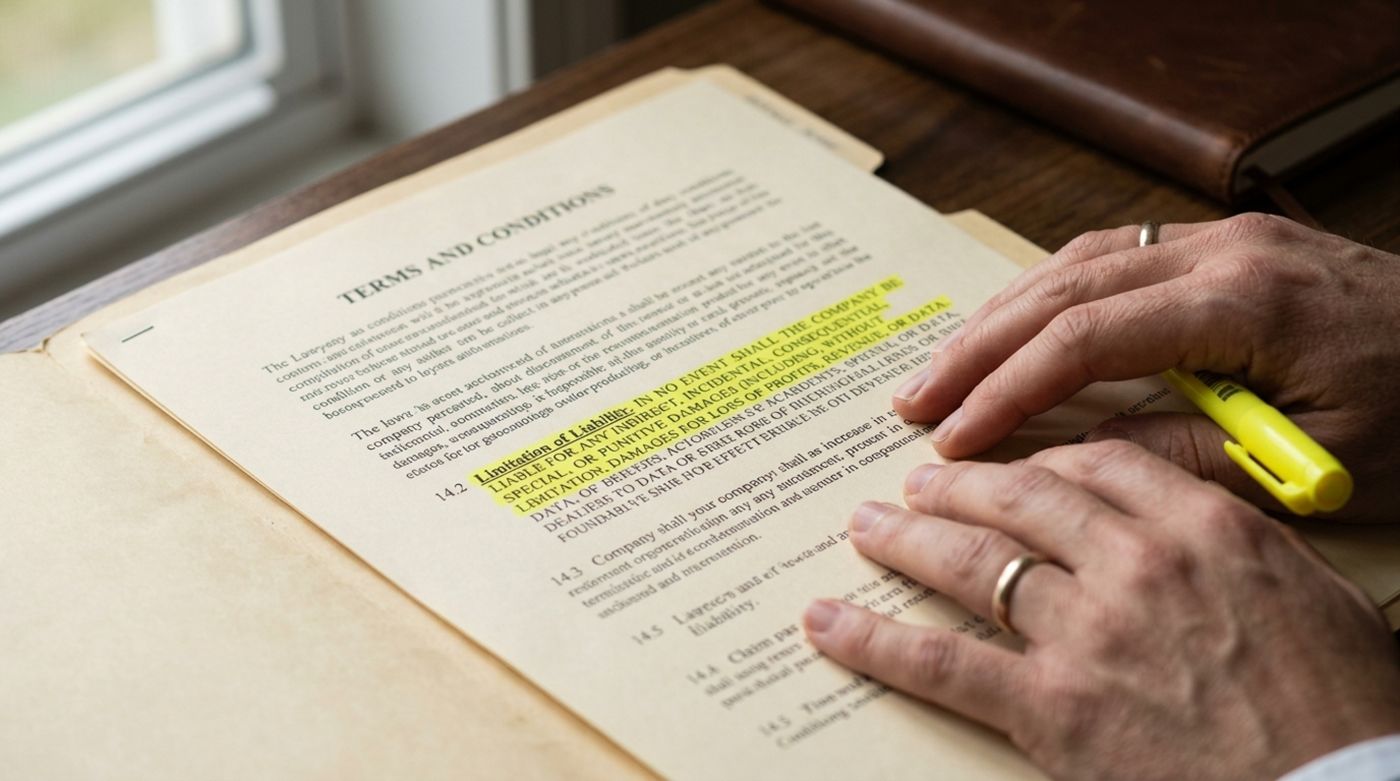
Negotiating Limitation of Liability Provisions in Commercial Agreements

A vendor’s draft arrives with one sentence near the end: neither party’s total liability will exceed the fees paid in the prior twelve months. In New York, a clear limitation-of-liability provision between businesses is generally enforceable as written, so the cap you sign is usually the cap you live with. However, the major exception is gross negligence, which New York public policy won’t let a party contract away. Nearly everything else, from the cap’s size to what it excludes, is negotiable.
This drafting stage is the moment that counts. At Oberle Law, PLLC, we negotiate limitation of liability provisions for businesses from our Suffolk County office in Bohemia, New York, and for clients nationwide. Before you accept a counterparty’s cap, contact us to schedule a free consultation and discuss what that clause would cost you if the relationship went wrong.
Most limitation of liability provisions do two jobs: they set a dollar ceiling on what one party can recover from the other, and they exclude certain categories of damages altogether, usually indirect, consequential, and punitive damages, and often lost profits.
The exclusion can matter more than the cap. If a software provider’s outage shuts down your ordering system for a week, the cost of restoring service may count as a direct damage. However, the courts often treat lost sales and departed customers as consequential damages. Exclude those, and even a generous cap may cover only a small slice of your actual loss.
New York courts generally enforce a clear limit on damages unless a special relationship between the parties, a statute, or an overriding public policy stands in the way. The most important policy limit is gross negligence. A party cannot shield itself from liability for conduct that “smacks of intentional wrongdoing” or shows reckless indifference to the rights of others.
That bar is high. New York courts regularly find that ordinary carelessness, even repeated mistakes, falls short. In practice, you should negotiate as if the cap will hold, rather than counting on a gross negligence argument to rescue you later.
New York law also voids clauses that let contractors escape liability for injuries caused by their own negligence in construction, maintenance, and repair work on real property. For sales of goods, the Uniform Commercial Code allows parties to exclude consequential damages unless the exclusion is unconscionable, and limiting damages for a commercial loss is not presumed unconscionable.
If an exclusive remedy, such as repair or replacement, fails its essential purpose, the buyer’s ordinary remedies can return.
In commercial contracts and negotiations, the structure of a cap often protects a client more than a higher figure would. If you are considering signing a commercial agreement in New York, review the following key points first.
Measurement: A cap based on fees paid in the prior twelve months can sit close to zero early in a contract. Fees payable over the full term, or a fixed dollar floor, can help close that gap.
Mutuality: Determine whether the cap protects both sides or only the party that drafted it.
Carve-outs: Discuss cap coverage for claims that fall outside the cap entirely, commonly breaches of confidentiality or data security, third-party indemnification, intellectual property infringement, willful misconduct, and unpaid fees.
Super-caps: Where applicable, negotiate separate, higher ceilings for specific high-risk claims when a full carve-out isn’t attainable.
When both sides are stuck on a number, a tiered cap that grows with the relationship, or a super-cap limited to data incidents, can give each party something real without unwinding the deal.
A cap has to work with the rest of the contract. If your counterparty promises to indemnify you for third-party claims but the cap applies to “all claims under this agreement,” that indemnity may be capped too, sometimes far below the exposure it was meant to cover. The contract should state plainly whether indemnity obligations sit inside or outside the cap. Insurance belongs in the same conversation.
A cap above a counterparty’s coverage may promise money it can’t pay, while a cap well below your potential losses leaves your business carrying uninsured risk. Requesting certificates of insurance and tying the cap to policy limits keeps the figure collectible.
A liability cap, the damages it excludes, and how it interacts with your indemnity and insurance terms together determine who absorbs the loss when a commercial relationship fails. Getting those pieces to work in your favor takes more than accepting or rejecting a counterparty’s number; it takes a deliberate structure built before you sign.
At Oberle Law, PLLC, our attorney, Constance Oberle Geoghan, has negotiated these provisions from the business side of the table. We can help you break a stalled cap negotiation by designing a structure, whether a targeted carve-out, a super-cap, or a smarter measurement formula, that protects what matters most to your business while keeping the deal on track.
Our Suffolk County commercial contract lawyer is dedicated to advising businesses from our office in Bohemia, New York, and serves clients nationwide. If a draft with a liability cap is waiting for your signature, call us at (917) 983-0632 or schedule a free consultation, and we’ll help you sign terms that match the risk you’re actually taking on.